Sewer line belly: what camera evidence justifies repair
Quick answer
A sewer line belly is a low section that retains water instead of maintaining continuous fall. Do not approve replacement from that label alone: request the complete camera recording, the sag's start and end footage, retained-water evidence, pipe condition, surface location, symptoms, ownership boundary, and a repair scope that explains how the finished grade will be verified.
Common questions
- How serious is a belly in a sewer line?
- Seriousness depends on documented retained water, the belly's length and location, recurring symptoms, solids accumulation, and the condition of the surrounding pipe. A brief or poorly positioned camera view is not enough to determine severity. Local acceptance criteria also vary.
- Can a sewer camera prove how deep a belly is?
- Ordinary CCTV can document where the view enters and leaves retained water, but a distance counter is not a grade survey. Ask how any depth, percentage, or slope was measured and what equipment supports it. A surface locator depth is also an estimate, not proof of pipe grade.
- Can pipe lining fix a sewer line belly?
- Do not assume it can. Cured-in-place lining is formed within the existing host pipe and is commonly used for defects such as cracks, leaks, and corrosion; that does not by itself demonstrate corrected grade. Require a project-specific design that explains how the low section and finished drainage will be addressed.
- What should a sewer line belly repair quote include?
- Comparable quotes should use the same start and end footage, repair length, depth and access assumptions, pipe material and diameter, permit and inspection requirements, surface restoration, bypass or sanitation needs, post-work testing, and final camera deliverables.
Source note: Checked October 14, 2026 against NASSCO assessment guidance, municipal lateral-video criteria, OSHA trench-safety guidance, and PVC pipe installation guidance. Local acceptance limits, permits, ownership boundaries, and repair requirements vary.
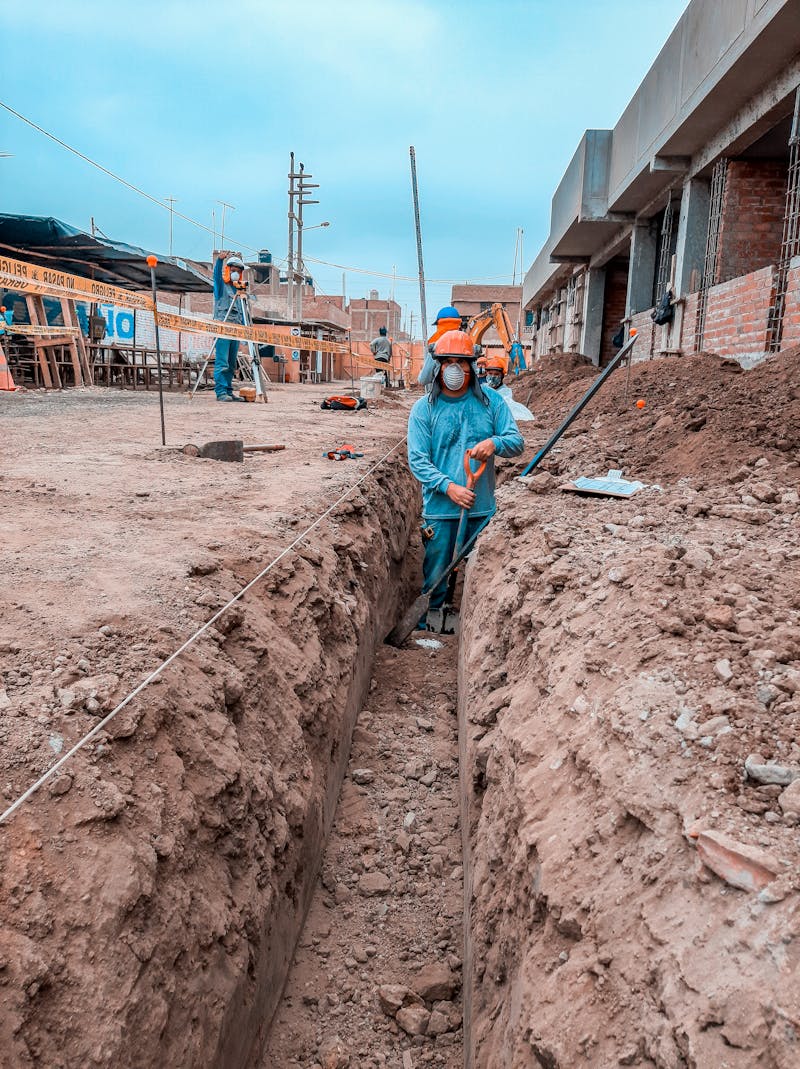
A sewer line belly is a low section of gravity pipe that holds water instead of maintaining continuous fall. It can contribute to recurring blockages, but the words “there is a belly” do not prove its severity, cause, or correct repair. Before authorizing work, connect the camera observation to a location, retained-water evidence, symptoms, surrounding pipe condition, and a scope that will actually address grade.
If wastewater is backing up, stop using connected fixtures, avoid contamination, and call qualified help. Review repair evidence after immediate risks are controlled.
What a sewer camera can—and cannot—prove
A continuous camera recording can show where the lens enters and leaves retained water and whether roots, debris, an offset joint, deformation, or other defects appear nearby. A distance counter can reference observations to the access point.
The same video usually cannot establish the cause outside the pipe, exact grade, soil support, or future movement. Locator depths and footage counters are planning aids, not surveyed elevations. Water can also look deeper when the camera is off-center, partly submerged, or passing an obstruction.
A useful conclusion documents retained water between two footage marks under stated conditions. If a report gives a depth or percentage, ask what was measured and how.
Sewer line belly camera-evidence checklist
Use this checklist with the inspector, plumber, seller, or property manager. Keep the original recording and report.
- Identify the inspected segment. Record the property, date, access point, direction, diameter, and whether the camera reached the public connection or another stated endpoint.
- Mark the belly’s limits. Request start and end footage, length, surface marks, and locator limitations. Distinguish camera-travel distance from surface distance.
- Document retained water. The recording should show the approach, entry, travel through the low section, exit, and pipe beyond it. Ask whether the line was cleaned and whether water remained after a controlled flow test stopped.
- Explain every severity number. If the report states a water-depth percentage, inches of sag, or pipe slope, it should name the measurement method. Do not turn a visual estimate into a precise claim.
- Record material and condition. Note material, diameter, joints, cracks, deformation, corrosion, roots, deposits, and repairs. A local sag in serviceable pipe differs from several defects across an aging run.
- Show both sides. Capture stable pipe upstream and downstream. If water blocks the view, ask whether another approved access or reverse pass can resolve the missing section.
- Connect the finding to symptoms. Log backup dates, which fixtures were affected, cleaning methods, removed material, and the footage where repeated obstructions occurred. One ambiguous image is weaker evidence than repeated trouble at the same documented location.
- Confirm access, ownership, and rules. Identify cleanouts, pipe depth estimates, hardscape, utilities, easements, the private/public boundary, and local permit or inspection requirements before bidding the repair.
For the full inspection deliverable—including continuous footage, defect pauses, a written report, and surface mapping—use the sewer camera inspection checklist.
Separate a documented sag from lookalikes
Standing water deserves investigation, but it is not a diagnosis by itself.
| What appears on camera | What to verify before calling it a belly |
|---|---|
| Water or debris obscures the lens | Whether the camera is centered, the line was prepared appropriately, and the view clears beyond a defined length |
| Roots or buildup hold back water | Whether qualified cleaning changes the retained-water pattern without damaging fragile pipe |
| A joint lip interrupts flow | Whether the problem is a localized offset, separation, or grade change and what lies on both sides |
| The image tilts or rolls | Whether camera position—not pipe slope—is changing the apparent waterline |
| The camera stops in deep water | Whether a downstream or reverse pass is feasible and whether the unviewed section remains inconclusive |
| Several fixtures drain poorly | Whether the evidence indicates a structural low spot, an active main sewer clog, or both |
Municipal criteria illustrate why context matters. Princeton, New Jersey’s lateral-video rules identify a sag or dip that ponds to at least 25% of pipe diameter, extends at least 10 feet, or may otherwise cause debris buildup as a defect for that program. That is a local criterion, not a universal homeowner rule.
Decide between monitoring, spot repair, and replacement
Match the scope to the evidence rather than choosing a method from the word “belly.”
Monitoring and maintenance
Monitoring may be considered when the full line is visible, the finding is limited, symptoms are not recurring, surrounding pipe is serviceable, and no local or transaction rule requires correction. Set action triggers such as another backup, increased retained water, solids, or deterioration at reinspection.
Cleaning can remove an obstruction and improve the inspection, but it does not correct pipe grade. Repeated cleaning without a defined review point can hide the lifetime cost of an unresolved problem.
Spot excavation and relay
A localized excavation lets the contractor prepare continuous support and relay the low section to approved alignment and slope. It can fit a well-located belly with sound connections.
Charlotte Pipe’s guidance calls for firm, stable, uniform bedding and says blocking should not change grade or intermittently support pipe over low sections. The PVC Pipe Association likewise specifies continuous, uniform support. A quote should identify bedding, compaction, connections, testing, inspection, and post-work video.
Longer replacement
Price a longer replacement for multiple low areas, widespread failed joints, deformation, collapse, or too little sound pipe for a spot repair. Compare the exact segment and restoration limits in the sewer line replacement scope guide.
Trenchless proposals
Cured-in-place pipe is installed within the host pipe; NASSCO describes it as structural rehabilitation for defects including cracks, leaks, and corrosion. That does not show that a low section will gain the required grade. Pipe bursting also needs a project-specific design, not a generic promise.
Ask any trenchless bidder to state in writing:
- Whether the proposed work changes the low section’s elevation or only rehabilitates pipe condition
- Which measurements and access pits support the proposed alignment
- How finished drainage will be verified
- What happens if post-work CCTV still shows retained water
Use the trenchless versus excavation comparison to review access and rehabilitation tradeoffs, but let the documented grade problem control method selection.
What drives sewer line belly repair cost?
There is no responsible national price for the phrase “sewer line belly.” Quotes change with the measured work, region, and local requirements. Key scope items include:
- Repair length, pipe diameter, material, and depth
- Yard access and equipment reach
- Soil, groundwater, nearby structures, and utility conflicts
- Driveway, sidewalk, floor, landscaping, or street restoration
- Traffic control, easements, and public right-of-way work
- Cleanout installation and temporary wastewater control
- Permits, design, inspection, and utility coordination
- Bedding, backfill, compaction, connections, and testing
- Disposal, sanitation, post-work video, and unseen conditions
Ask each bidder to separate base work, allowances, exclusions, and change-order triggers. A bid omitting restoration or post-repair verification is not comparable with a complete scope.
Comparable-quote checklist
Give every contractor the same video and request the same written fields:
- Belly start and end footage, surface marks, and proposed repair length
- Estimated pipe depth and the method used to locate it
- Existing material, diameter, and defects included in the scope
- Monitoring, spot repair, or replacement rationale
- Finished alignment, slope requirement, and verification method
- Excavation limits, access, utility locating, and trench-safety plan
- New pipe, connections, bedding, backfill, and testing
- Permit, inspection, ownership boundary, and right-of-way responsibility
- Surface protection, restoration, and pre-/post-work CCTV
- Warranty coverage, exclusions, schedule, payment milestones, and change-order rates
Do not enter an excavation to check the work yourself. OSHA warns that all excavations can be hazardous and that cave-in protection, utility location, safe access, water control, and competent-person inspections may be required. Keep excavation and sewer-gas exposure within qualified professional controls.
Useful next steps
If the evidence is incomplete, ask for the original video, report, and marked location before soliciting repair bids. If you need to prepare access, find the cleanout without opening it during a backup by following the sewer cleanout guide.
For a purchase or sale, keep the report, maintenance history, permits, bids, and ownership confirmation together. Do not convert an unmeasured camera label directly into a repair credit.
Choose the narrowest action the evidence supports: document more, monitor under stated conditions, relay a defined low section, or replace a longer defective run. A qualified local plumber or sewer contractor should connect the footage to the design, permits, and final verification.
Sources and standards checked
- NASSCO: Pipeline and lateral assessment
- NASSCO: Pipe rehabilitation
- Princeton Sewer Department: Lateral video inspection requirements
- City of Portland: Sewer video, photo, and map guidelines
- Charlotte Pipe: Plastics technical manual
- PVC Pipe Association: Installation guide for solid-wall PVC sewer pipe
- OSHA: Trenching and excavation

Flow Control HQ Editorial Team
Independent trade-focused editorial team