PEX expansion vs. crimp vs. clamp: which system fits?
Quick answer
Choose a PEX connection by the standard marked on the tubing and the manufacturer's approved system—not by PEX-a or PEX-b alone. F1960 cold expansion, F1807 or F2159 crimp, and F2098 clamp assemblies can all be appropriate when the pipe, fitting, ring or clamp, tool, listing, and instructions form a matched system.
Common questions
- Is PEX expansion better than crimp?
- Not universally. Expansion can provide a larger fitting waterway, while crimp can be checked immediately with the specified gauge. Compatibility, layout, tool control, inspection requirements, and the manufacturer's complete listed system matter more than a blanket ranking.
- Can PEX-a use crimp or clamp fittings?
- Some PEX-a tubing is qualified for F1807, F2159, or F2098 insert systems as well as F1960 expansion, but the letter alone is not approval. Read the tubing print line and the current manufacturer manual before matching components.
- How do I know which fittings work with my PEX pipe?
- Record the manufacturer, product line, size, ASTM F876 marking, potable-water certification mark, pressure ratings, and fitting-system designations printed on the pipe. Confirm the exact fitting, ring or clamp, and tool in current manufacturer documentation.
Source note: Reviewed August 28, 2026 against the PPI PEX Plumbing Distribution Systems Design and Installation Guide, Uponor and Wavin installation manuals, RWC/SharkBite instructions, and current ASTM scope pages. Product instructions and local code control the actual installation.
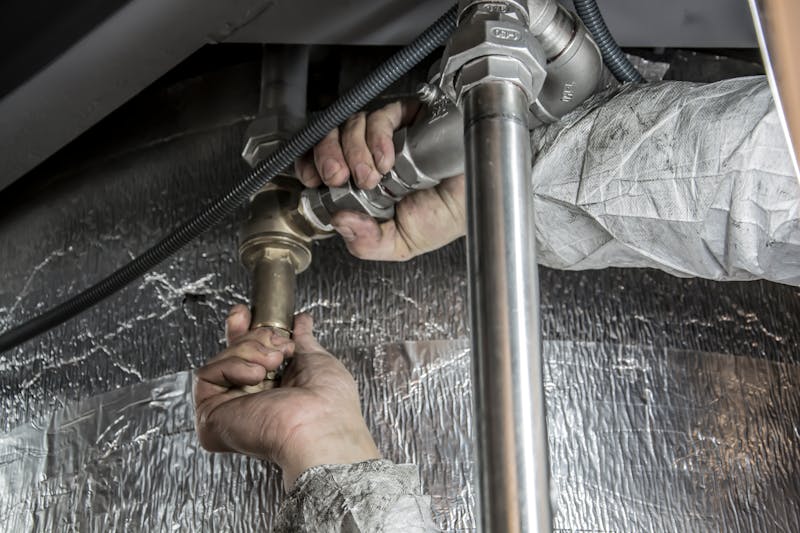
Choosing a PEX connection means proving that every component belongs together. The pipe print line and current manufacturer instructions—not pipe color or the PEX-a/PEX-b label alone—should drive the decision. One manufacturer may qualify PEX-a for expansion and insert fittings while another has a narrower scope.
PEX connection types at a glance
| Decision point | F1960 cold expansion | F1807/F2159 crimp | F2098 clamp (cinch) |
|---|---|---|---|
| How the joint is made | Pipe and reinforcing ring are expanded, the fitting is inserted, and the pipe recovers around it | A copper crimp ring compresses pipe onto a metal F1807 or plastic F2159 insert fitting | A stainless steel clamp locks around pipe over a compatible F1807 or F2159 insert fitting |
| First compatibility check | Pipe print line lists F1960; fitting, ring, pipe, and tool match the approved system | Pipe print line lists the fitting standard; fitting material, copper ring, and tool match | Pipe and insert fitting are approved for the clamp system; clamp and tool meet F2098 requirements |
| Joint verification | Full insertion at the fitting shoulder, correct ring position, proper tool rotation or expansion pattern, and specified recovery time | Ring location plus the manufacturer’s go/no-go gauge procedure; tool calibration also matters | Correct clamp location and closed-ear form, with tool calibration checked as its instructions require |
| Flow-path question | Fitting waterways are generally larger than same-size insert fittings, but use manufacturer flow data for design | Insert fittings reduce the waterway locally; actual effect depends on size, fitting count, layout, and demand | Uses the same insert-fitting flow path as the approved crimp-style fitting beneath the clamp |
| Cold-jobsite issue | Pipe and ring recover more slowly as temperature falls; follow the system’s cold-weather procedure before testing | There is no expansion recovery period, but pipe, tool, and test limitations still apply | There is no expansion recovery period, but the clamp tool must remain correctly calibrated |
| Practical fit | Crews equipped and trained for an approved expansion system; designs where the published fitting waterway helps | Crews with size-matched, calibrated crimp tools and a defined gauge check | Work where an approved clamp tool and its access profile suit the assembly |
This matrix is not permission to mix brands or components. A qualified plumber, the local authority, and the exact submittal should settle the final system.
Start with the ASTM markings, not the PEX letter
The Plastics Pipe Institute’s 2026 PEX guide says the tubing print line should identify the fitting standards the manufacturer recommends. Look for designations such as F1960, F1807, or F2159 alongside the pipe’s other markings and certification seal. For a clamp assembly, also verify F2098 on the clamp/tool documentation and confirm that the pipe maker approves that combination.
The standards describe different assemblies:
- ASTM F1960 covers cold-expansion fittings with PEX reinforcing rings for compatible PEX or PE-RT tubing within the standard’s scope.
- ASTM F1807 covers metal insert fittings used with copper crimp rings or qualifying alternate stainless steel clamps.
- ASTM F2159 covers specified plastic insert fittings used with copper crimp rings or qualifying alternate stainless steel clamps.
- ASTM F2098 covers stainless steel clamps used to secure compatible PEX or PE-RT tubing to F1807 or F2159 insert fittings.
An ASTM designation does not replace the listing or installation manual. Confirm that the pipe, fitting, ring or clamp, size, application, and tool are approved together. Potable-water work also needs the drinking-water certification required by the local authority.
Wavin’s current handbook illustrates why the letter shortcut fails: its A-Pex pipe documentation lists F1960, F1807, and F2159 compatible fittings, while its SuperPEX documentation lists F1807 and F2159. Read what is printed and submitted for the product in front of you.
Pipe-marking and submittal worksheet
Photograph the print line and complete this worksheet for every pipe product or size before buying tools or approving a bid.
| Record this | What to copy or confirm | Why it matters |
|---|---|---|
| Pipe identity | Manufacturer, product line, nominal size, SDR, lot/date code, and PEX material designation | Separates similar-looking tubing and preserves traceability |
| Pipe standards | ASTM F876 or other pipe standard shown | Establishes the tubing specification claimed by the manufacturer |
| Fitting-system marks | F1960, F1807, F2159, or another designation exactly as printed; document F2098 clamp approval separately | Identifies connection families the tubing maker has qualified |
| Potable-water listing | Certification agency seal and listing shown for drinking-water use | Confirms the component is evaluated for the intended potable application |
| Pressure/temperature marks | Ratings printed on pipe and in the current data sheet | Prevents a standard’s maximum scope from being mistaken for the product’s operating limit |
| Fitting and ring/clamp | Manufacturer, catalog number, material, nominal size, standard, and lot if available | Proves the parts belong to the proposed assembly |
| Tool control | Tool model, head or jaw size, calibration/check method, and condition | Connection quality depends on the specified tool geometry and maintenance |
| Installation document | Manual title, revision date, and relevant page | Keeps the job tied to current, product-specific instructions |
| Project approval | Permit number, approved submittal, inspector notes, and installer | Creates a handoff record for concealed work and warranty questions |
| Test record | Medium, temperature, pressure, duration, gauge ID, result, and inspector | Shows the completed system was tested under an approved procedure |
If a print line is unreadable or the installer cannot produce the supporting manual, pause the selection. Do not assume that a fitting is compatible because it slides into the pipe.
How joint verification differs
F1960 cold expansion
The installer makes a square cut, positions the specified ring, expands the pipe and ring with the approved head, then seats the fitting while the material contracts. Expansion count, tool rotation, ring position, recovery time, and rejection criteria are product-specific.
Wavin identifies overlapping tool imprints as evidence that its rotating head worked properly and gives a maximum shoulder gap. Uponor likewise emphasizes tool condition, head rotation, full insertion, and cold-weather adjustments for ProPEX.
F1807 or F2159 copper-ring crimp
Crimp systems place a copper ring over the pipe and an approved insert fitting inside it. Ring distance, jaw alignment, tool closure, and calibration are controlled steps. Wavin directs installers to gauge its completed ring in at least two positions: the go portion should pass and the no-go portion should not. A failed joint is cut out rather than double-crimped. Follow the selected system’s gauge rule.
F2098 stainless clamp
The approved tool compresses a clamp’s raised ear after the pipe is seated on an F1807 or F2159 fitting. RWC/SharkBite calls for tool-calibration checks and a visual check of the closed-ear form. Crimp and clamp share an insert-fitting geometry, but their rings, tools, and checks differ. A worm-drive hose clamp is not an F2098 PEX clamp.
Flow path: compare the layout, not one fitting
Cold expansion enlarges the pipe end, so an F1960 fitting can have a larger internal passage than a same-size insert fitting. Crimp and clamp fittings fit inside the unexpanded bore, creating a local step-down. That does not support a universal flow-loss percentage. Performance depends on pipe size and length, fitting count, elevation, supply pressure, fixture demand, and manufacturer loss data. Sweeping bends and fewer fittings may matter more than the connection family.
If low pressure is the reason for the project, document static and flowing pressure first with the home water-pressure guide. Ask the designer or plumber for a calculation based on the proposed layout rather than a sales claim.
Cold weather and pressure testing
Expansion recovery slows in cold conditions. Uponor states that below 40°F (4.4°C), ProPEX contraction takes longer and needs fewer expansions; it warns against using a heat gun on engineered-polymer fittings. Those are Uponor instructions, not a universal F1960 recipe. Crimp and clamp do not wait for recovery, but cold still affects pipe handling and testing.
Pressure testing must follow the local code and the complete system manufacturer’s procedure. The plan should address:
- Whether water, air, or another permitted medium is allowed
- Ambient and water temperature, including freeze protection
- Components that must be isolated from test pressure
- Conditioning steps required for PEX-a
- Test pressure, duration, allowable change, and gauge accuracy
- Safe exclusion zones when compressed air is permitted
- Inspection timing before walls, insulation, or concrete conceal the work
Wavin and Uponor use different procedures, so cite one approved system document instead of borrowing numbers from multiple brands.
What to require in a plumber’s proposal
Make the connection method a written scope item. The proposal should include:
- The pipe and fitting product lines, ASTM designations, potable-water listings, and sizes.
- The ring or clamp specification and the approved installation tools.
- The distribution layout and any manufacturer flow data used for sizing.
- Cold-weather controls, support, UV protection, penetrations, and transition fittings.
- Permit, inspection, pressure-test, and concealment responsibilities.
- Warranty terms for the pipe, fittings, and labor, including any system-matching conditions.
- Photos of print lines and completed joints before they are hidden.
Use the repiping scope checklist across bids. The whole-house repipe cost guide separates connection choices from project economics, while the PEX vs. copper vs. CPVC comparison covers the earlier material decision.
The practical decision
Choose F1960 expansion when the selected pipe explicitly supports it, the crew has the approved tool and training, and the layout benefits from the manufacturer’s published fitting geometry. Choose F1807/F2159 crimp or F2098 clamp when the selected pipe and insert fittings support that assembly and the crew can execute its calibration and verification process consistently.
The best PEX connection is the matched, listed, documented system that can be installed, inspected, pressure-tested, and warranted as specified. Before authorizing concealed potable-water work, have a qualified plumber and local authority confirm the submittal and permit requirements.
Sources and standards checked
- PPI PEX Plumbing Distribution Systems Design and Installation Guide, third edition
- Uponor PEX Piping Systems Design and Installation Manual
- Wavin A-Pex and SuperPEX Technical Handbook
- RWC/SharkBite Piping Systems Installation Guide
- ASTM F1960 cold-expansion fitting scope
- ASTM F1807 metal insert fitting scope
- ASTM F2159 plastic insert fitting scope
- ASTM F2098 stainless clamp scope

Flow Control HQ Editorial Team
Independent trade-focused editorial team