Pressure-reducing valve failure: symptoms and fixes
Quick answer
A pressure-reducing valve may be failing when downstream pressure stays too high, remains too low under normal demand, changes erratically, or no longer responds to adjustment. A pressure that rises only after all fixtures close can also indicate thermal expansion, so record static, flowing, and time-lapse readings before replacing the valve.
Common questions
- How do I know whether a PRV is bad?
- Use a gauge to compare downstream pressure at rest, during flow, and after fixtures close. A valve that cannot maintain or respond to an appropriate setting may need service, but supply changes, blockage, a bad gauge, and thermal expansion must be ruled out.
- Why does pressure creep up overnight?
- Pressure can rise in a closed plumbing system as heated water expands. A leaking or poorly controlling PRV is another possibility. Compare pressure with the water heater active and inactive, and have the expansion-control system checked.
- Can I adjust a pressure-reducing valve myself?
- Only if the exact manufacturer instructions, safe access, gauge location, and local rules support it. Small measured adjustments are different from opening, rebuilding, or replacing a pressurized valve.
Source note: Reviewed September 23, 2026 against Watts LF25AUB-Z3 instructions and EPA WaterSense service-pressure guidance. The installed valve manual and local plumbing authority govern final settings and replacement work.
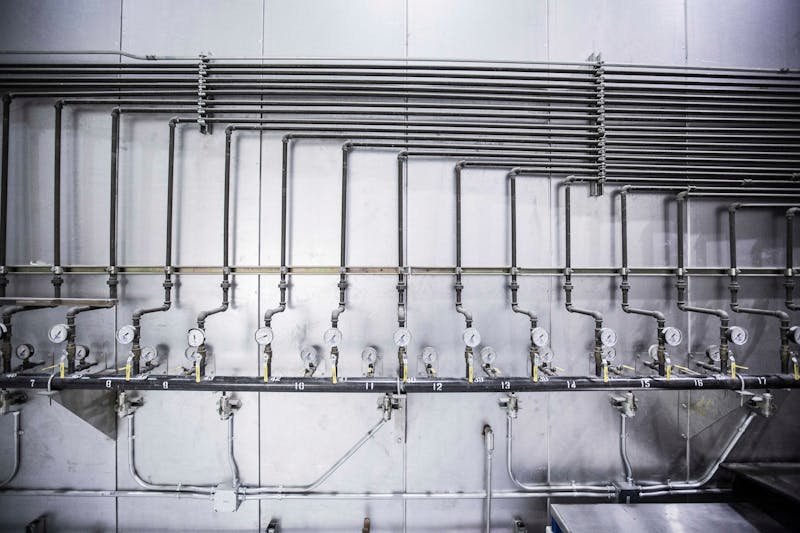
When a home’s pressure is wrong, the pressure-reducing valve is an easy suspect—but not every high or low reading means the valve has failed. A useful diagnosis compares pressure at rest, under demand, and over time. That separates PRV behavior from municipal supply changes, clogged piping, and thermal expansion.
A PRV is usually installed on the building water supply to reduce higher incoming pressure to a controlled downstream level. Confirm that your property actually has one, record its make and model, and identify which hose bib or test port is downstream before testing.
If you have not yet established whether the problem is constant, demand-related, or tied to water-heating cycles, start with the whole-house high-water-pressure diagnostic before diagnosing this valve.
PRV failure symptoms by gauge pattern
| Gauge pattern | What it can suggest | What to check before replacement |
|---|---|---|
| Downstream static pressure stays high | Valve set too high, debris, worn seat, internal damage, or incorrect installation | Gauge accuracy, upstream pressure, flow arrow, adjustment response, thermal expansion |
| Pressure is acceptable at rest but drops sharply during use | Restricted strainer or valve, undersized supply, partially closed shutoff, utility-side limit, or high demand | Compare multiple fixtures, verify main valve position, check supply and pipe-size constraints |
| Pressure is low at rest and during flow | Low utility or well-system supply, incorrect setting, failed valve, or restriction | Ask utility about work, test upstream if qualified, inspect filters and treatment equipment |
| Pressure rises slowly after all fixtures close | Thermal expansion in a closed system or pressure creep past the PRV | Compare cold and hot-water cycles; inspect the potable expansion tank |
| Adjustment produces little or no change | Gauge/setup error, valve at its range limit, blocked passage, damaged spring/diaphragm, or wrong flow direction | Follow the exact manual; stop if the valve must be depressurized or opened |
Do not diagnose from shower feel alone. A clogged showerhead, cartridge, branch line, or water heater can cause fixture-specific low pressure. Use the low shower pressure guide when only one area is affected.
Take three kinds of pressure reading
Use a potable-water pressure gauge with a range suitable for the system and a hose-thread connection in good condition. Attach it to a downstream hose bib or approved test point. Keep people away from the connection, and do not use a damaged bib or gauge.
1. Static pressure
Turn off known fixtures and appliances, then record the pressure. Note the time, whether the water heater recently fired, and whether irrigation or treatment equipment could operate automatically.
2. Flowing pressure
With the gauge still connected, open a known fixture and record the downstream pressure under demand. Test one moderate flow, then a realistic combined demand. A large drop adds evidence of a restriction or supply limitation; it does not identify the PRV by itself.
3. Time-lapse or overnight maximum
A gauge with a lazy or maximum pointer can show peaks after fixtures close. Reset it, record the starting pressure, and leave the system in normal operation. If the maximum climbs while the water heater heats a cold tank, investigate thermal expansion before blaming the regulator.
The broader home water-pressure guide explains how service supply, elevation, pipe size, filters, and fixtures affect these readings.
Distinguish pressure creep from thermal expansion
Watts’ LF25AUB-Z3 instructions specifically warn that thermal expansion occurs when water is heated in a closed system and describe opening a cold faucet briefly as one diagnostic clue. A check valve, backflow preventer, or PRV can make the potable system closed.
Use these observations for the service call:
- Does the rise track a water-heating cycle?
- Does opening a cold faucet immediately drop the gauge toward the regulator setting?
- Is there a potable expansion tank, and is it waterlogged, unsupported, isolated by a valve, or precharged incorrectly?
- Does pressure rise even when the water heater is off and the system is cold?
- Does the regulator hold steady under flow but allow the static reading to climb later?
The water-heater expansion tank guide covers closed-system diagnosis and precharge setup. Never cap a temperature-and-pressure relief valve or treat it as normal pressure control.
Adjustment, service, or replacement?
Adjustment may be reasonable when
- The valve is correctly installed and accessible.
- Upstream pressure is stable enough for a meaningful test.
- The model’s instructions identify an adjustment procedure.
- The downstream gauge responds smoothly to small adjustments.
- The chosen setting is acceptable to the fixture, appliance, code, and utility requirements.
For the Watts valve cited below, clockwise adjustment raises the set pressure and counterclockwise adjustment lowers it after loosening the locknut. Do not assume that direction or range applies to another model. Make small changes and recheck both static and flowing readings.
Service may be possible when
Some PRVs have replaceable strainers, seats, diaphragms, or service kits. Match the exact model, size, suffix, connection, and generation. The system must be shut off and depressurized as the manufacturer directs; opening a live valve is unsafe.
Replacement is more defensible when
- The body is leaking, cracked, severely corroded, or physically damaged.
- The valve cannot hold a safe setting after supply and expansion issues are excluded.
- Approved parts are unavailable or rebuilding would not address body wear.
- The valve is incorrectly sized, oriented, or connected for the application.
- Repeated service has not restored stable pressure.
What to put in a replacement quote
If testing supports replacement, use the water pressure regulator replacement cost and quote checklist to compare the complete scope rather than the headline total.
A comparable quote should identify:
- Valve manufacturer, model, nominal size, pressure range, and connection type
- Measured upstream and downstream static and flowing pressures
- Whether unions, a bypass, shutoffs, gauge ports, or pipe changes are included
- Expansion-control inspection and any separate work proposed
- Permit, inspection, water interruption, and restoration responsibilities
- Startup setting and post-installation readings under the same test conditions
- Warranty and service access
If the shutoff arrangement is uncertain, review the emergency water shutoff guide before scheduling work. Pressure changes can also worsen water hammer, but an arrestor is not a substitute for correcting excessive system pressure.
A practical decision rule
Replace the PRV only after the evidence points to the regulator. A bad valve usually shows a repeatable control problem: it cannot reach, hold, or recover to an appropriate downstream setting. Pressure that changes only with water-heater cycles points toward expansion control; pressure that fails only at one fixture points farther downstream.
Sources and standards checked
Connect regulator readings to the rest of the pressure system
These guides help distinguish PRV control, thermal expansion, fixture restriction, pipe noise, and shutoff planning.
- Home water-pressure troubleshooting
Check supply, piping, treatment equipment, and fixture causes around the PRV.
- Expansion tank symptoms and sizing
Investigate pressure that rises during water-heater recovery in a closed system.
- Low shower pressure
Separate a single-fixture restriction from a building-wide pressure problem.
- Water hammer explained
Check pipe movement and fast-closing valves after supply pressure is controlled.

Flow Control HQ Editorial Team
Independent trade-focused editorial team