How to Install a Dishwasher
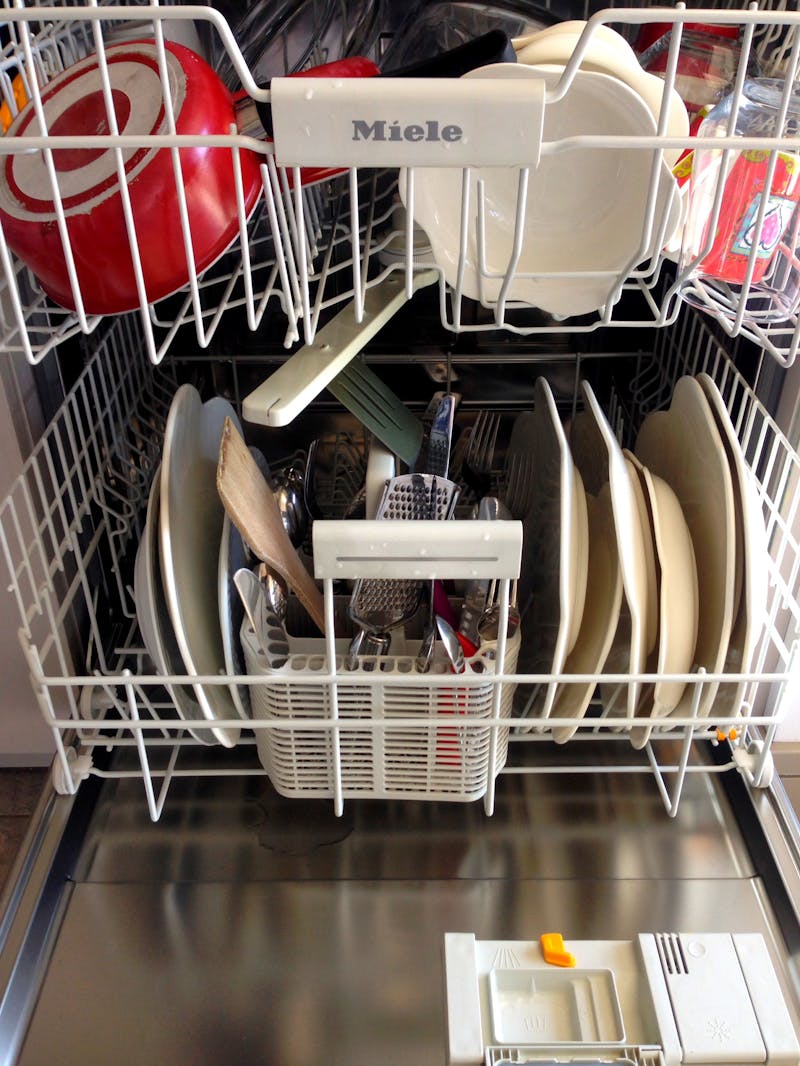
Installing a dishwasher yourself can save $150 to $300 in labor costs and is well within reach for a confident DIYer. The job involves three systems — plumbing, drainage, and electrical — which sounds complicated but follows a logical sequence. This guide covers everything from pulling out the old unit to making the final connections and running the first test cycle.
Before You Begin: Safety and Planning
Turn Off Power and Water
This is non-negotiable. Locate the dedicated 20-amp circuit breaker for the dishwasher and switch it off. Verify it is dead with a non-contact voltage tester before touching any wires. Then shut off the hot water supply valve under the sink. The dishwasher connects to the hot supply line (not cold), so only the hot side needs to be closed.
Check What You’re Working With
Open the cabinet under your sink and look for three things:
- The water supply connection point — typically a 3/8-inch compression fitting on the hot shutoff valve or a separate dishwasher elbow fitting on the supply line
- The drain connection point — the dishwasher drain hose connects either to the garbage disposal inlet port or to a dedicated dishwasher drain tee on the sink tailpiece
- The electrical connection — most dishwashers use a direct wire connection through a knockout in the junction box on the unit itself; some newer homes have a dedicated outlet
Measure the Space
Standard dishwashers are 24 inches wide, 24 inches deep, and 35 inches tall, designed to slide under a standard 36-inch countertop. Before ordering a unit, measure your opening width, depth, and height. Allow 1/8 inch of clearance on the sides. Compact 18-inch dishwashers exist for smaller kitchens — just confirm you are matching the replacement to the opening.
Tools and Materials
Tools:
- Adjustable wrench
- Flathead and Phillips screwdrivers
- Channel-lock pliers (slip-joint)
- Non-contact voltage tester
- Level
- Wire stripper and wire nuts
- Drill and 7/8-inch hole saw bit (if running new supply line hole)
- Bucket and towels
Materials:
- Braided stainless dishwasher supply line, 6 feet (5/8-inch OD with 3/8-inch female compression connection)
- Drain hose (usually included with new dishwasher; 5/8-inch ID)
- Hose clamps (two stainless worm-drive clamps for drain)
- Wire nuts (properly rated for gauge used)
- Electrical tape
- Thread seal tape (PTFE)
- Dishwasher elbow fitting if not pre-installed on unit
Step 1: Remove the Old Dishwasher
Open the door and remove the lower rack. Unscrew the access panel at the bottom front — usually two screws. Inside you will find the water supply line connection, the drain hose, and the electrical junction box.
Disconnect in this order:
- Drain hose — use pliers to slide the hose clamp back and pull the hose off the drain port
- Supply line — place a towel under the fitting, then loosen the compression nut with an adjustable wrench
- Electrical — open the junction box cover, separate the wire nuts, and disconnect the wires
- Mounting screws — two screws secure the mounting brackets to the underside of the countertop
Lower the leveling legs and slide the dishwasher out. Be careful not to scratch flooring — sliding cardboard under the feet helps.
Step 2: Prepare the New Dishwasher
Before sliding the new unit into the opening, make these connections while you have easy access:
Install the Drain Elbow (If Separate)
Some dishwashers ship with the drain elbow packaged separately. Thread it onto the drain port on the pump housing (lower-left or lower-right depending on model). Wrap the threads with two layers of PTFE tape, thread the elbow on by hand, then snug it with pliers. Direct the elbow toward the sink cabinet opening.
Install the Water Inlet Elbow
Locate the water inlet valve on the lower front of the unit. Install the 90-degree brass elbow fitting (if supplied) by wrapping the threads with PTFE tape and threading it into the valve, directing the open end toward the supply side. Do not over-tighten brass fittings — firm hand-tight plus a quarter turn with a wrench is correct.
Pre-Route the Drain Hose
Feed the drain hose through the opening in the cabinet side panel so it is ready to connect once the unit is positioned.
Step 3: Water Supply Connection
Run a braided stainless supply line from the dishwasher’s inlet elbow to the hot shutoff valve under the sink. Most installations use a dedicated 3/8-inch to 5/8-inch dishwasher supply line.
If your shutoff valve does not have a dishwasher port, install a dual-outlet valve or a brass tee fitting. Wrap all threaded connections with PTFE tape (two to three wraps). Hand-tighten, then snug with a wrench — one-quarter turn past hand-tight is sufficient. Do not gorilla-tighten braided supply lines; the rubber washer inside the female fitting does the sealing.
Recommended supply line: Eastman 6-Foot Braided Dishwasher Supply Line on Amazon
Step 4: Drain Connection — High Loop vs. Air Gap
This is the most misunderstood part of dishwasher installation. The drain hose must be routed correctly to prevent dirty water from the sink drain from siphoning back into the dishwasher.
High Loop Method
The high loop is the simpler and most commonly used approach. Route the drain hose up as high as possible inside the sink cabinet — ideally securing it to the underside of the countertop — then loop it back down to connect to the garbage disposal or drain tee. The high point of the hose should be as close to the countertop height as possible, at least 20 inches above the floor.
Secure the hose at its peak with a zip tie or hose clamp through a hole in the cabinet. This prevents the hose from sagging over time.
Air Gap Method
An air gap is a small cylindrical fitting that mounts on the countertop or sink deck. The dishwasher drain hose connects to the inlet port on the air gap; a second hose runs from the air gap outlet down to the disposal or drain tee.
Air gaps provide physical backflow prevention that cannot fail — no moving parts. Many local plumbing codes require them, particularly in California. If your municipality requires an air gap and you currently have one, install a new one. If you are in an area that permits the high loop, either method is acceptable. Check your local code if you are unsure.
Air gap fitting: Watts Air Gap for Dishwasher Drain on Amazon
Connecting to the Garbage Disposal
Most garbage disposals have a dishwasher knock-out port on the side. If this is your first dishwasher installation and the port has never been used, the knock-out plug must be removed. Insert a flat screwdriver into the port and tap it with a hammer until the plug breaks free, then fish it out with needle-nose pliers. Do not skip this step — failing to remove the plug will block drainage entirely.
Push the drain hose onto the disposal inlet port and secure with a worm-drive hose clamp. Tighten firmly — dishwasher drain hoses under pressure will pop off if not clamped properly.
Connecting to a Drain Tee (No Disposal)
If you do not have a garbage disposal, the drain hose connects to a dishwasher drain tee fitting installed on the sink tailpiece above the P-trap. Replace the standard tailpiece with a dishwasher-wye tailpiece. The hose slips over the barbed inlet and is secured with a hose clamp.
Recommended drain hose: Supco Universal Dishwasher Drain Hose on Amazon
Step 5: Electrical Connection
Confirm the breaker is still off and verify with your voltage tester before touching wires.
Direct Wire Connection
Remove the cover from the electrical junction box (usually at the bottom front of the dishwasher). You will find three wires coming through the conduit: black (hot), white (neutral), and green or bare copper (ground).
Your home’s supply wires should match. Connect:
- Black to black (wire nut)
- White to white (wire nut)
- Green or bare copper to the ground screw on the junction box chassis or to the green ground wire
Fold the wires into the box and replace the cover. Do not leave any exposed wire connections outside the junction box.
Cord and Plug Connection
Some dishwashers are sold as cord-and-plug models or can be converted with an accessory cord kit. If your installation location has a 3-prong grounded outlet (NEMA 5-20R), a cord kit simplifies installation and makes future removal easier. Connect the cord wires the same way: black to black, white to white, green to ground.
Step 6: Slide In and Level the Dishwasher
Before sliding the unit in, make sure no hoses or wires are in the path of the rear legs. Tilt the dishwasher back slightly, route all connections under or through the cabinet opening, then slide the unit in slowly.
Leveling: The dishwasher must be level side-to-side and have a very slight front-to-back pitch (front slightly higher than rear, approximately 1/4 inch) to ensure proper drainage. Adjust the front leveling legs by turning them clockwise to raise and counterclockwise to lower. Most dishwashers have a rear leg adjustable from the front with a long screwdriver through a hole in the chassis.
Place a level on the inner door rail to check side-to-side level. Adjust until the bubble is centered.
Secure the Mounting Brackets
Extend the mounting brackets at the top of the dishwasher (or side-mount if you have stone countertops — never screw up into granite or quartz). Drill pilot holes and drive the screws into the underside of the wooden countertop. This prevents the dishwasher from tipping forward when the door is open and a heavy dish rack is extended.
Step 7: Test Everything Before Closing Up
- Turn the hot water supply back on slowly and check the supply line connection for drips — both at the valve and at the dishwasher inlet
- Turn the breaker back on
- Run a short rinse cycle or the shortest wash cycle available
- During the cycle, check under the sink for drain hose leaks at both the dishwasher end and the disposal/tee end
- After the cycle, open the unit and check that water has drained completely
- Reinstall the access panel
Recommended Dishwasher Products
-
Bosch 300 Series Dishwasher (SHPM88Z75N) — exceptionally quiet at 44 dBA, third rack, flexible loading. View on Amazon
-
GE GDP665SYNFS Dishwasher — reliable performance, dry boost technology, fingerprint-resistant stainless finish. View on Amazon
Troubleshooting Common Issues
Dishwasher not draining: Check that the knock-out plug was removed from the disposal inlet. Verify the drain hose is not kinked. Confirm the high loop is actually high — a sagging hose creates a pocket where water collects.
Water leaking from door: The door gasket may need replacement, or the unit may not be level. A dishwasher that pitches forward will let water pool at the door seal and eventually leak.
Dishwasher tripping the breaker: The circuit may be shared — dishwashers require a dedicated 20-amp circuit. If yours is shared, have an electrician add a dedicated circuit.
Grinding noise during drain: Foreign objects (broken glass, a bone fragment, a seed) in the drain pump. Run the disposal before starting the dishwasher to clear the disposal side, and check the drain pump filter if your model has one.
A properly installed dishwasher, leveled and connected with correctly routed drain hose, should perform reliably for a decade or more. Take your time on the drain routing and electrical connections — those are where most installation problems originate.

Flow Control HQ Editorial Team
Independent trade-focused editorial team